
Western Red Cedar or rough-cut Douglas fir: the best wood for a Texas pergola
We build with two woods. Western Red Cedar and rough-cut Douglas fir. Both make a good pergola. They cost different amounts and they age differently. Here's what each one does in the sun, the rain and the clay, and how to pick.
Last updated: September 2026
The short answer
If you want the least upkeep and the most natural rot resistance, pick Western Red Cedar. If you want big rough-cut timber for less money and you'll stay on top of the stain, pick Douglas fir. Both go on engineered piers, both get stained, and both look like real timber framing.
Cheap wood isn't cheap if you rebuild it. Price the pergola you'll have in year ten, not the one you'll have on day one.
Western Red Cedar
Cedar is what we build with by default. It carries natural oils that resist rot and insects without chemical treatment. It's light for its size, so a long beam doesn't sag under its own weight as much. And it's stable. It moves less than most woods when it goes from a wet spring to a dry August.
Cedar also takes stain evenly. That matters more than people think. A pergola is all exposed wood, so the finish is the whole look. Cedar holds a semi-transparent stain evenly and ages to a warm color under it.
Where cedar falls short
It costs more per board foot than fir. It's softer, so it dents if you bang a ladder into it. And it isn't invincible. Cedar sitting in wet dirt or standing water will still rot. That's why our posts sit on raised steel bases on engineered piers, never buried in the ground.
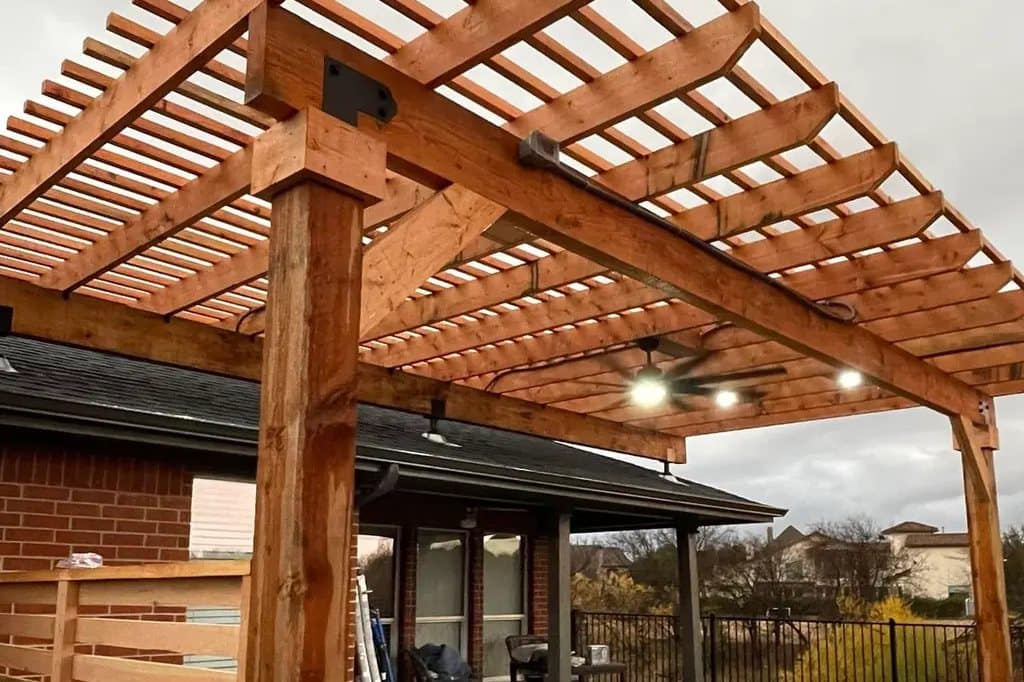
Rough-cut Douglas fir
Douglas fir is a structural wood. It's stronger and stiffer than cedar, and it comes in the big rough-sawn sizes that make a pergola look like timber framing. Big posts, deep beams, knee braces. It usually costs noticeably less than cedar in the same sizes.
The catch is rot. Fir doesn't have cedar's natural resistance. Left bare, it grays, checks and starts to break down where water sits. It can last a long time outdoors, but only if it's sealed well and resealed on schedule, and only if no part of it sits in water.
When fir makes sense
- You want the heavy timber look and the budget won't stretch to cedar in those sizes.
- The structure will have a roof, so the top of every beam stays dry.
- You're fine restaining on a tighter schedule than cedar needs.
Under a solid roof, fir holds up much better than it does on an open pergola. The roof keeps rain off the tops of the beams and rafters, which is where water sits and rot starts. On an open slat pergola, every top surface takes the rain.
Why rough-cut
Rough-cut lumber comes straight off the saw instead of being planed smooth. It keeps its full size, so an 8x8 is closer to a true 8 by 8. The surface has texture you can see and feel, and it soaks up stain deeper than a smooth board. On big posts and beams, that texture is what makes a pergola look like timber framing instead of deck lumber.
We use rough-cut on the heavy members, the posts, beams and braces. Rafters and trim can go either way depending on the look you want.
Why we don't use treated pine
Pressure-treated pine is the cheap option on a lot of quotes. We don't build with it. Treated lumber often shows up wet from treatment and dries out in Texas heat. As it dries it shrinks, checks and can twist, so a post that went up straight can bow. It also takes stain unevenly until it's fully dry. On a structure that's all exposed wood, that's the whole look.
Treated pine is like a new pair of boots that shrinks in the sun. It fits on day one. It pinches by August.
What about the Texas weather
Heat and dry air pull moisture out of wood fast. Then a week of rain puts it back. That swing is what causes checking, the cracks that open along the length of a post. Every wood checks some. Cedar checks less than fir. Neither is a defect. It's wood drying out.
One detail helps with any species: posts cut free of the heart center, often labeled FOHC. The center of the log is where the biggest cracks start. A post cut away from it stays tighter. It costs more and it's worth asking for on big posts.
The ground matters too
North Texas sits on expansive clay. It swells when wet and shrinks when dry. A post set in concrete in that soil can move, and a wood post buried in wet clay will rot no matter the species. We set posts on engineered piers with standoff bases, so the wood never touches the ground and the footing sits below the zone where the clay moves most.
Stain and upkeep
Every exterior wood needs a finish in Texas sun. The UV grays the surface and dries it out. A good semi-transparent stain slows that down and keeps the color. Plan on refreshing it every few years, sooner on the sunny side and on horizontal surfaces that catch rain.
- Cedar: stain at build, refresh every few years, the least fuss.
- Douglas fir: seal well at build, including end grain, and stay on schedule.
What we build with
Our pergolas and patio covers are Western Red Cedar or rough-cut Douglas fir. Cedar is the default. Our reference job was a freestanding nine-post cedar pergola that came in at $17,000 with permit and stain. If budget is tight, especially on a roofed cover, we'll price Douglas fir side by side and tell you straight what changes in upkeep.
Cedar pergola, reference job
Open-top cedar pergola. This is what a real nine-post job cost. A smaller one costs less.
| What | Includes | Price |
|---|---|---|
| Cedar pergola, open top, 9 posts | Freestanding two-layer open-top pergola in Western Red Cedar with no roof covering. Nine 6x6 posts on decorative steel bases, 2x10 beams with profiled end cuts, a rafter layer and 2x2 top purlins, knee braces at every post-to-header connection, decorative connectors, and demo of the old structure.
| $15,900 |
If neither number works, go smaller before you go cheaper. A smaller cedar or fir pergola will outlast a bigger one built from the wrong wood.
Questions
Is cedar worth the extra money for a pergola?
For a structure you see every day, yes. It resists rot without chemicals, moves less, and takes stain evenly. You pay more up front and less over the life of the pergola.
How long does a cedar pergola last in Texas?
Built right, a long time. The keys are keeping the posts out of the dirt on raised bases, keeping a finish on the wood, and not letting water sit on flat surfaces. The most common early failure is a post buried in wet clay.
Can I use Douglas fir for a pergola?
Yes, with care. Seal it well, including the cut ends, raise the posts off the ground, and restain on schedule. It does best under a roof, where the tops of the beams stay dry.
Do you build pergolas out of treated pine?
No. We build with Western Red Cedar or rough-cut Douglas fir only. Treated pine often goes up wet, then shrinks, checks and twists as it dries in Texas heat.
Do I have to stain a cedar pergola?
You don't have to, but in Texas sun bare cedar grays quickly and dries out. A semi-transparent stain keeps the color and slows the weathering. We stain at the end of every build.
Keep reading
What a cedar pergola costs in Texas
What a Western Red Cedar pergola costs in Dallas-Fort Worth and East Texas, from a signed nine-post job, and what moves the price up or down.
Pergola or patio cover: which one you actually need
The real difference between an open cedar pergola and a roofed patio cover in Texas. Shade, rain, heat, permits and what each one costs.
What a cedar patio cover costs in Texas
Roofed cedar patio cover pricing per square foot in Dallas-Fort Worth and East Texas, from a signed job, with worked examples and what's not included.
Pergolas or see every published price.
Get a number
Reading is cheaper than guessing
Tell us what you are building and we will price it against a written scope. Or call 469-721-0129.